Valigia d’artista - Interview with Angelo Barcella by Davide Dallomo
Why horses?
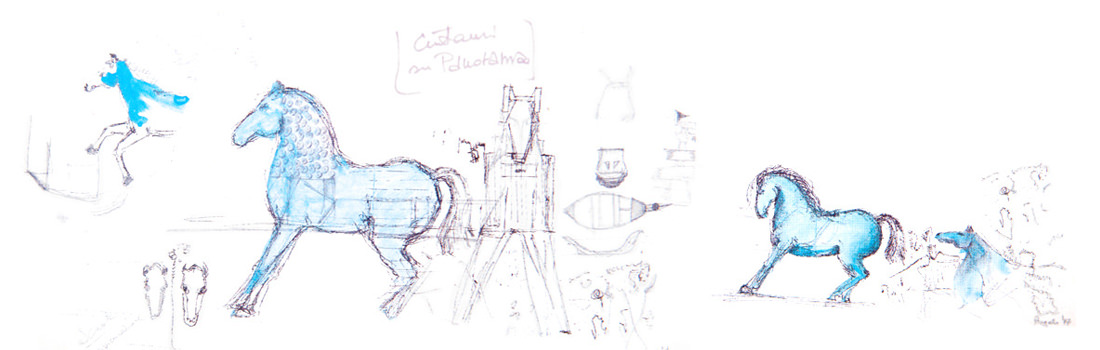
I began when I made a rocking horse for my daughter. My ambition was to build something large, at home, all by myself. I cut multilayer board and then glued the parts; it was a job I do myself without too much equipment and machinery. Three years later I started doing this again. Horses seemed to be an obvious choice: I hated the base in sculpture, I wasn’t interested in expression, psychology, telling a story; my concept was that of a free shape with horses, a subject that has always been present in art and history. My first work is much more naturalistic, and then I went increasingly towards abstraction.
How did you learn about, get to know, horses?
I began drawing them from reality, to see how they were actually shaped, because I really did not know it. Then I looked into major sculptural and painting works, the Parthenon, Paolo Uccello. At the beginning I had problems with the anatomy, so I worked and studied, and I invented my horse, which is larger and larger, bigger and bigger, still but strong, tense, without a rider. My sense of shape comes to me from Egyptian sculpture, which I love deeply, and from African sculpture too: sculpture as a fetish. Not a representation, but existence. Not the Laocoont, but the pyramid in the desert: a concept of sacredness. The history of our culture is representation, telling a story: the rearing horse, the victorious rider. But my work, maybe even the paintings, tends to shake free of the story side, I mean it doesn’t tell a story: front and profile figures, removing all that is incidental, putting the stress on shape, making it as pure and as abstract as possible.
What does cinema have to do with it?
Cinema was light, the invention of light on a body, an object, a place, to highlight them as much as possible, to render their atmosphere, to make them alive as best as possible. But I do sculpture now: the light for the sculpture will have to be created by someone else. Sculpture can exist in the dark too - you can touch it - and it lives in any kind of light. If there were only one kind of light it would be the end of sculpture; it would become a scenario, a backdrop. Nor do you have one single, compulsory angle of observation, although you certainly have the best angle - while others are less good - but this is simply the limitation of the artist, the fact that one is unable to create a work that is totally perfect from all angles of vision. A sculpture should be looked at with all possible types of light: diffuse, direct, etc.
What about dimension in your sculptures?
There is scale: usually, you see a horse from a lower point of observation, from the bottom upward, and this must be taken into account. Moreover, the same treatment of matter may become artificial on a work of a smaller size.
Why colour?
Colour means freedom from naturalism and from doing something that tells you a story. Often this setting free is difficult, because it is the work of art that requires, asks for its own colour to be set free, and it often happens that I don’t find the right colour at the first attempt: then I must throw everything away and start again from the beginning.
Have you considered using any other material?
I have not had the time for this. Multilayer board is an industrial product of our era, dead and stupid, but it holds within itself exceptional possibilities of surprise, with its wonderful differences in level, which underline shape so perfectly. I have felt quite free here; there were no previous uses of this material, so I did not have to fight against anything, or to bow under any tradition. Multilayer board forces me to respect axiality and bilateral symmetry. In my work, axiality is essential, and merges perfectly with the concept of fetish that I mentioned before. And then, there is construction: mine is not chisel work, first and foremost it is planning and assembly. So you see, I think I have investigated my material as much as possible, with all the limitations that come from such a restricted choice.
Painting: what happens in 1985?
What happened was I hit my head against Pontormo, and I said to myself: I want to understand how he worked, what is behind this marvellous work. And, in re-doing his work I did understand something. Every millimetre is weighed and planned, so is every thickness of the lines. I understood one thing in particular: painting really is a fascinating world. Scenery is born in Tuscany: it is what I used to see from my window. But it really is a world that I had already seen 20 or 30 years before, and that I had photographed, the hills, the soft lines, and no sharp mountains. Movement is the movement of the human figure, the exchange between the body and the scenery. Within my work there is a soft line that links the horse, the human figure, the scenery.


